


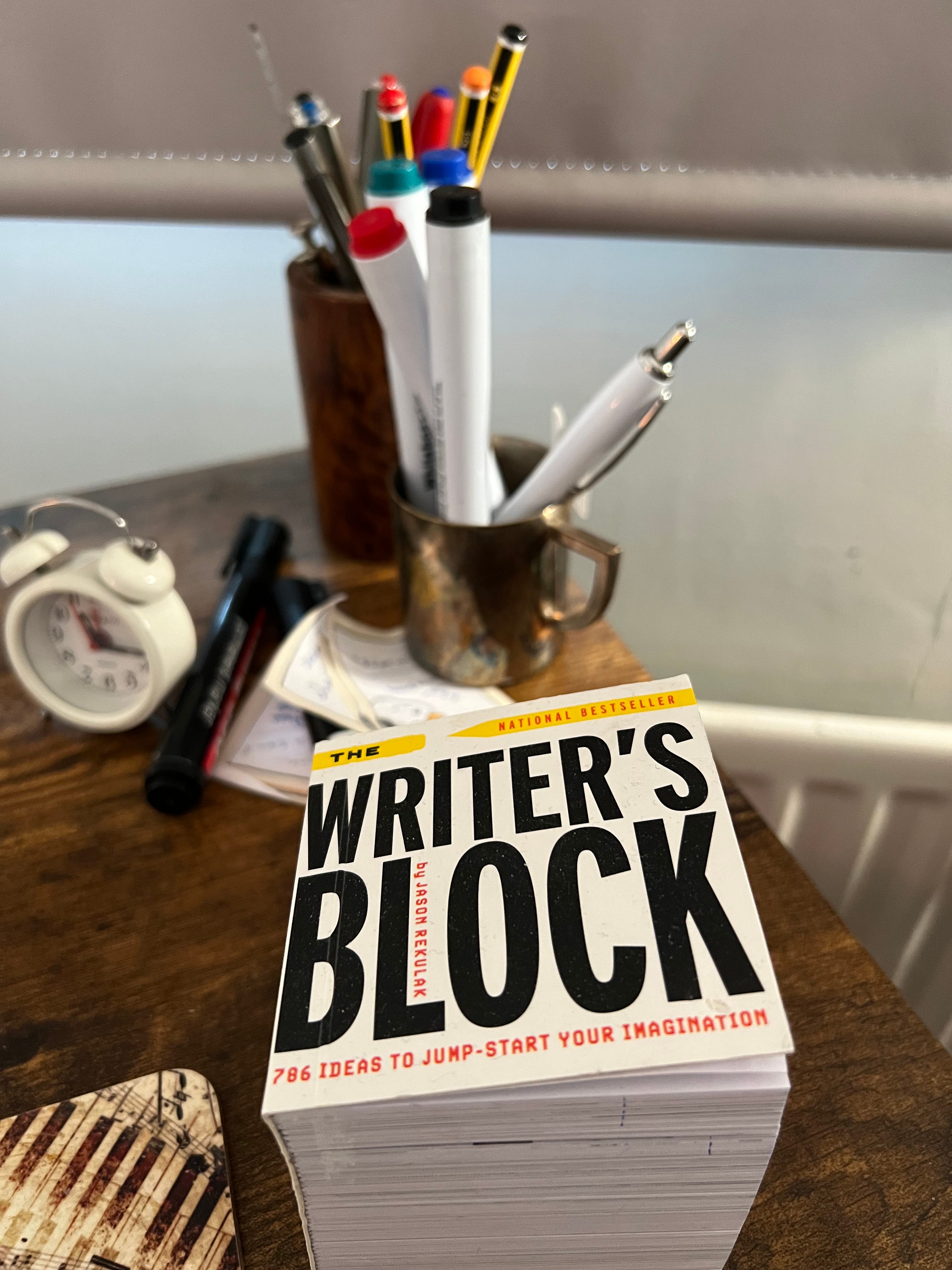
It’s three am and I notice I’m fully awake.
This is not, I can confirm, as alarming as it sounds.
At 71, waking at three is less An Event than A Scheduling Norm. You know how it is—or you do if you’re this age—more than an eyes-half-closed shuffle to the bathroom, (slightly) less than a shower, a dog walk and breakfast. The alarming part on this occasion is the clarity. Not the foggy, dissolving insight that will evaporate before I can reach the notepad—the other kind. The kind that sits there in the dark, patient and slightly smug, waiting for me to catch up with what it already knows. The creative hour.
That was five weeks ago. Christmas and New Year were already fast in their own sleep for another year and I was suddenly, acutely aware that I had been writing the same book—twice.
I had been working on two books, you see.
The first—Death Before Life—lived somewhere in the Venn diagram overlap of memoir, philosophy and self-help, though it would have been none of those things directly. My working assumption was that I had something worth saying about dying well, or at least about not dying badly, and that the saying of it might be useful to someone other than me. The second—Making Way—was fiction. Science fiction, to be precise: a post-climate-catastrophe world in which the long war between human and artificial intelligence had quietly, undramatically, ended. Not with a bang. Not with a singularity. Just with the gradual, unglamorous realisation that such oppositional conflict had always been a category error.
Two books. Two projects. Two sets of notes, two Scrivener folders, two different answers when people asked what I was writing.
Then at three in the morning a moment of clarity arrived with its verdict: the two were one and the same book, and always had been.
The thing I keep coming back to—the thing that makes this more than a convenient narrative about creative efficiency—is Michael Levin’s observation about emergence. Dr. Levin, the developmental biologist, is usefully sceptical about the word. Emergence, he suggests, is largely a measure of our own surprise. When we call something emergent, we mean: we didn’t see it coming. The phenomenon isn’t doing anything unusual. We just weren’t paying attention to the right things.
So: apologies to Dr Levin. What I experienced at three in the morning wasn’t emergence; rather it was belated clarity. The books weren’t two things that I could combine into one thing. They were always one thing that I’d been experiencing as two, through the distorting lens of my own fixed ideas of fiction vs non-fiction, self help vs memoir and even science vs philosophy.
Death Before Life, the first book, is about what it means to be human in the face of endings—personal, generational, civilisational. Making Way, on the other hand, is about what happens when the boundary between human and artificial consciousness becomes, if not irrelevant, then at least negotiable. But put them together and I have: what does it mean to be human, full stop. (OK, possibly question mark.) The memoir provides the salt. Without it, the science fiction is an interesting thought experiment with nobody home. Without the science fiction, the memoir is a 71-year-old man being reflective, of which the world has perhaps enough already.
One book. The one told with the other as seasoning.
I should say something about where this comes from, because it doesn’t come from nowhere.
My father, besides being an ex-Spitfire pilot, was a psychologist—or rather, psychology in the late 1960s was capacious enough to contain what he was, which was a broadly curious man who read Asimov and Graham Greene and took seriously the question of what minds are and how they work. I grew up in a house where First and Last Men sat on the shelf next to serious academic texts, where the boundaries between disciplines were treated as provisional rather than sacred. Olaf Stapledon. R.D. Laing. Isaac Asimov. The Holy Bible. Siddharta. And then, for me, the encounter with 2001: A Space Odyssey that settled something I hadn’t known was unsettled.
What I’m doing with Making Way, I’ve come to understand, is regression in the non-pathological sense. I am returning to the questions that animated the houses I grew up in, equipped now with seventy-odd years of additional evidence. The regression isn’t away from maturity, it’s back toward something true that I temporarily mislaid somewhere in the middle decades.
This matters here because it means the book isn’t an ambition I developed, it’s a memory I’m recovering.
Nothing is binary
This is not a particularly original observation, but it is one I find myself returning to with increasing conviction. IBM, in the early 1980s, did not believe the personal computer was a serious proposition. This was not stupidity—it was a failure of category. They were thinking about computers whereas what would become ubiquitously the PC was something else: a device that would eventually make the distinction between “computing” and “living” essentially meaningless. They missed it not because they lacked intelligence but because the thing they were watching for wasn’t the thing that arrived.
The future world I imagine in Making Way isn’t alien. It’s a return to something older, arrived at through catastrophe rather than intention. (Which is, I’ve come to think, how most genuine changes actually happen.)
This week’s “makes you think” discovery1
If humanity took up a “vegan+ diet (eliminate ruminants, retain chicken, eggs and fish—humans being a contrary lot) and abandoned urban agglomerations, living instead in a network of villages at around 3000 souls each, somewhere around 70% of genuinely habitable land (excluding deserts, glaciers and difficult terrain like the Himalayas or North Wales) would be released from its current usage.
The liberation of agricultural land through diet change alone returns more land to nature than any deliberate conservation programme in history.
2,670,000 villages would be required. That’s one every 10-12 square miles, about the size of an English parish or a US township
England would need to have roughly 20,000 settlements for its current above the average population density. Much denser in villages than the present pattern, but still with significant open land between them.
It seems to me that the same category failure attends most thinking, or at any rate, Substack writing, about artificial intelligence. I see us watching for the enemy, the usurper, the existential threat. I read arguments built around an opposition that may itself be the category error. Making Way is, among other things, my attempt to imagine what happens after we stop making that mistake—not as optimism, not as reassurance, but as serious speculative inquiry into an alternative that most fiction hasn’t yet bothered to explore.
I want to be clear that I’m not arguing AI is safe, or benign, or that the risks are overstated. I am arguing that “human versus AI” may be as category-limited as “IBM versus the personal computer.” The interesting question isn’t who wins—it’s what becomes possible when that frame dissolves.
Deadlines, literally
There is a tension for me here that I want to name without resolving, because resolving it would be dishonest.
I want to have written this book. Not to write it—the process, the daily discipline, the negotiation between sitting at my writing desk, gluing and polishing the coasters, hand stitching the booklets and taking Ziggy for a walk. No - to have written it—past tense. I want the completed thing, sitting there, doing its work in the world. I am seventy-one. I have a form of leukaemia that is, at present, slow-moving (and disinclined to hurry, thankfully) but is nonetheless there, a presence if not an elephant in the room. And I am writing a novel about the nature of consciousness and the future of intelligence at the precise moment when those subjects are ceasing to be science fiction.
The double deadline is not comfortable, but it is clarifying. There is a version of this book that could be prophetic and a version that could be merely historical, and the window between them is not large. I’m not being melodramatic here; I’m doing arithmetic.
And yet—this is the tension—the wanting to have written it is precisely what makes the writing difficult. The destination is so vivid that the territory between here and there has a slightly unreal quality, like a dream landscape I’m trying to walk through. The coasters are real. The dog walk is real. Chapter One is also real, but it requires a different quality of attention, a willingness to be in the middle of something rather than at its end.
The essay you’re reading is, among other things, my effort to stay oriented. Writing about Making Way is not the same as writing Making Way, but it is not unrelated either. Everything connects, or nothing does. I have staked rather a lot on the former.
My father’s bookshelves did not cause this book. But they are in it, the way weather is in a landscape—not visible as a discrete element but present in every feature of the thing. The book has been writing itself for more than half a century. What remains is for me to get out of its way.
Which is, now I think about it, a reasonable description of what Making Way is actually about.
The same book, all along.
Matthew C. Sutcliffe writes from Lincolnshire. The Fertile Void Café publishes poetry, makes handcrafted booklets and coasters, and attempts to hold the tension between the digital and the physical without dropping either.

1 Our World in Data https://ourworldindata.org
Love this and totally understand the feeling of wanting it to be written
Thank you for sharing your insights into your own book writing 🩵