


Real men, with or without quiche
I learned stuff as I grew up, though no one taught me it.
It might be more accurate to say that I absorbed it, or osmoted it. The tests weren’t formal, but they were real. They weren’t graded but how well you did mattered more than any certificate. It didn’t help to be intelligent, let alone intellectually gifted; in fact either of those was a significant disadvantage. What mattered was fitting in. There, before me, was this world, offering me safety in numbers, mates to lark with, a bit of freedom and a degree of success that wasn’t measured in money or job titles, although both of those would come in later.
I measured my penis size in the style of Adrian Mole. I measured my maleishness in terms of how many boys who could play soccer or already had a girlfriend called me a mate.
My lessons were in the dog-eared books full of Rugby Jokes & Songs—a sort of alternative hymnal-&-missal for a boy who had hormones he didn’t know existed. I learned many of them by heart, singing along at the back of the bus; retelling in a huddle on the beach. They gave me real life lessons that the newly invented sex education curriculum missed altogether.
And there were girls. Everywhere. I’d spent most of my school life to that point in single sex schools where there was definitely no sex, well, none you could talk about. And at 13¾ I moved to a much bigger school. Comprehensive, they called it and it was certainly that. Everyone, pretty much, went to it.
But the girls! I mean, at the end of my first term there, just a couple of weeks shy of fourteen, a girl in our class was leaving for foreign parts (Bristol, from memory) and she went round the class at break hugging the other girls and kissing all of us boys. A light peck on the cheek was all it was but oh my! The shock of realising that her lips were actually warm—that hadn’t figured in any of my immature fantasies thus far.
Telly gave me Benny Hill, Frankie Howerd and Till Death Us Do Part
That’s how it went on: testing the water, hesitatingly at times, checking out other boys’ responses, adapting, adding a little of this, clipping out a little of that. As the terms and years went by, I learned the code of this club: the boys club. Telly gave me Benny Hill, Frankie Howerd and Till Death Us Do Part, free of counterbalance. Home gave me a sense of what was right—which I still retain—but back then it was only for Sunday best and family weddings, or when helping Dad do the garden. It didn’t offer an effective survival strategy for changing from a good little boy into an aspiring young man. Others, worse off than I, had dads who believed housework was their mums’ work and what’s more, it began at the garden gate.
Bruce Lee could kick through a wall; Bruce Willis could take a bullet and still win. The Terminator could not be bargained with, nor debated away from his mission. For an aspiring young man, these were not fantasies exactly—they were the operating instructions for a system whose tests I had to pass, if I wanted to be a man’s man, a bloke amongst blokes, one of the lads. Tests you sat in school corridors and gymnasium changing rooms (and always at the back of the bus) were simply the junior version of the adult entrance examinations. Be hard. Be capable. Know stuff. Don’t need anyone.
I passed reasonably well, as it turned out; well enough, at any rate, to spend nearly four decades not noticing what joining the club had cost—what I had quietly stopped being able to see.
The Real Pivot
I was in my mid fifties when someone who loved me looked at my full collection of badges and said something that began a tectonically slow shift in me.
“But you’re a poet really, Matthew.”
She wasn’t being unkind. It wasn’t an accusation, it was a statement of recognition—of something still there underneath the composite and composed performance. I felt uncomfortable—who was I without my company car, my suits and silk ties, my seat on the Board, my salary? It was, in retrospect, everything I needed to hear.
What followed was neither straight nor quick and certainly not an arc of redemption. There was Smirnoff. There was loss. There was traumatically life-changing news. There was a period during which the grip on the rope was, at times, genuinely tenuous. But the rope held—or rather, I held it, though I wouldn’t have put it that way at the time. Gestalt Therapy training helped. Phil helped. Somewhere in amongst it all came a slow realisation that there was no destination. No journey’s end at which I would finally arrive as the corrected version of myself. Only the gradual, undramatic business of letting go of what had never really been me in the first place.
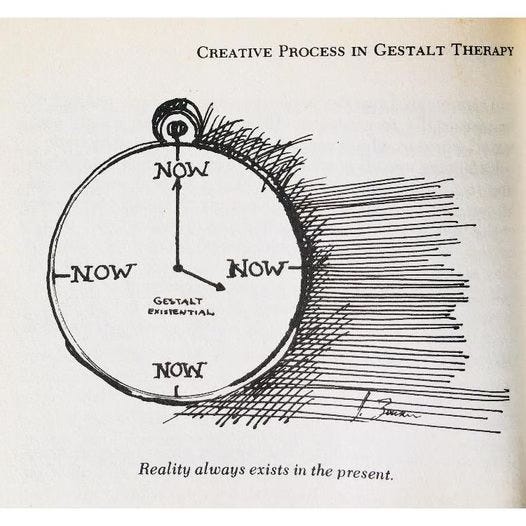
Joseph Zinker, Creative Process in Gestalt Therapy, 1977
… cometh the man
In the summer of 1940, the BBC gave J.B. Priestley five minutes after the nine o’clock news on a Sunday evening.
Churchill was already on the radio—magnificent, irreplaceable, the great man in his finest hour. Priestley came on afterwards: a novelist from Bradford, son of a schoolteacher, a man who’d stood as an ordinary soldier in the actual mud of the Somme and come home and got on with things. He spoke like someone who’d stood in a queue for bread and milk. He talked about ordinary people doing ordinary things in an extraordinary situation. Within months, forty percent of the adult population was listening. He gave people, one contemporary observed, what their leaders had always failed to provide: an ideology that didn’t require a legendary hero at its centre.
Churchill had him taken off the air in October 1940.
Priestley was not, it should be said, a straightforwardly admirable figure in all respects. He had his own substantial blind spots—the kind that come with being a confident man of a particular era. The point is not the man; the point is the mode. He didn’t wait for history’s permission. He didn’t need a crisis of sufficient scale to justify speaking. He had a slot, a voice, and something genuine to say. He showed up, Sunday after Sunday, and said it.
There is, in many decent men right now, a version of the Churchillian temptation: the instinct to wait for a figurehead. Someone appointed by events to mobilise the silent majority—the Anti-Tate, perhaps; someone with the platform, the profile and the moral authority to lead the charge. We can find comfort in that instinct because we can outsource our responsibility to a man who hasn’t arrived yet and who very well may not.
Meanwhile the campaigns run. They have always run—remember the War on Drugs? FRANK told a generation of teenagers that drugs were dangerous (DARE did the same in America). Teenagers were unpersuaded, because teenagers can smell an adult agenda from considerable distance, and because being told what to think by an institution is almost perfectly designed to produce the opposite effect. Any initiative to mobilise us in a Men Against Misogyny campaign will fail for exactly the same reason—it will be something aimed at men, done to men, which is completely the wrong register, confirming the passivity it claims to be addressing.
What, then?
In 1986, a computer scientist called Craig Reynolds wrote a programme to simulate the flocking behaviour of birds. He called his simulated birds “boids”. What he found was this: you don’t need a leader. You don’t need a conductor. You need three simple rules—stay close, avoid collision, move in roughly the same direction—and what emerges, from thousands of individual small adjustments, is a murmuration. The shape no one designed, with a coherence no one directed.
Boys don’t need a figurehead. They need to be able to see, in the ordinary texture of their ordinary days, men behaving like decent human beings towards women. Not perfectly and not heroically; just—decently. In the conversation at the dinner table or in front of the telly over a pizza. The uncle who doesn’t laugh at misplaced ribaldry. The teacher who names the thing in the room. The man next door who treats the woman on his doorstep like a person. The bus driver. The Amazon delivery driver. None of them will know they are being watched. The boy watching won’t know he’s watching either. That’s fine. That’s the point.
There’s a film—Shane, 1953—that most people remember as being about the guns. What’s missed is that it’s about a boy watching men, trying to work out what a man is supposed to be.
The scene that matters comes long before the shooting starts: Shane and Joe Starrett, the homesteader, working together to shift a massive tree stump from the field—something neither can move alone. Joe, the father, is the hero in that scene and Shane sees it. Joey the boy, is watching both of them. (Schaefer calls him Bob in the novel; Stevens’ film gives him his father’s name, Joey—which is itself significant.) Later, Shane tells Joey: “A man has to be what he is, Joey. Can’t break the mould. I tried it and it didn’t work for me.” He means it kindly. He’s also wrong. That line is the film’s mistake, and perhaps the era’s. The mould we have been pressed into can and does break, quietly, without dramatic music, one ordinary Tuesday at a time.
Shane rides out at the end because he has to—the lone hero is constitutionally incapable of staying, of being present, of being the thing the boy actually needs. Joey calls after him across the valley.
Shane doesn’t come back.
Afterword: my To Be Done list
Read:
Virginia Woolf, Three Guineas. A sharp account of how male institutions reproduce themselves.
Reni Eddo-Lodge, Why I’m No Longer Talking to White People About Race about what it costs to name the thing in the room.
On Substack: More jeanette winterson. More Anna Wharton. More Ros Barber. More Linda Caroll. Women who have already said everything that needs saying, and said it better and keep saying it—which is where this series began.
Terry Real, I Don’t Want to Talk About It. I haven’t read this nor even had heard of the author until I began researching for this series. He is a therapist who writes about men’s silence without making men feel terrible about it.
Watch:
Shane with Alan Ladd (1953). This time paying attention to the stump scene.
Thelma and Louise1 (1991) Watch it again, more carefully this time, as a man without defending myself against it.
Promising Young Woman (2020). New to me and I anticipate this being uncomfortable in exactly the right way.
Action:
Create a TINY FOLDED POEMS booklet, working title “Of Misogyny and Men”
Have one serious conversation with another man who may very well not see things as I do on this matter.
Ask my MP why he hasn’t responded yet to my letters.
Find opportunities to listen openly, in conversation, to women who have something to say.
Ask you what you’re going to do.
“What are you going to do?”

1 (Fits nicely after Desperately Seeking Susan, watched last night with White Ink with Anna Wharton’s online Film Club—thanks for letting me join in.)
Related Essays
The Fertile Void Café runs on readers, not algorithms. If this essay made you think — or made you uncomfortable in a useful way — consider subscribing. And if you’d rather hold something real in your hands, our shop has that covered too.
Now, Now, Now, Now, Now.
The time is Now.
Beautifully observed.
Here's to murmurations that quietly change the world.
Well said!