


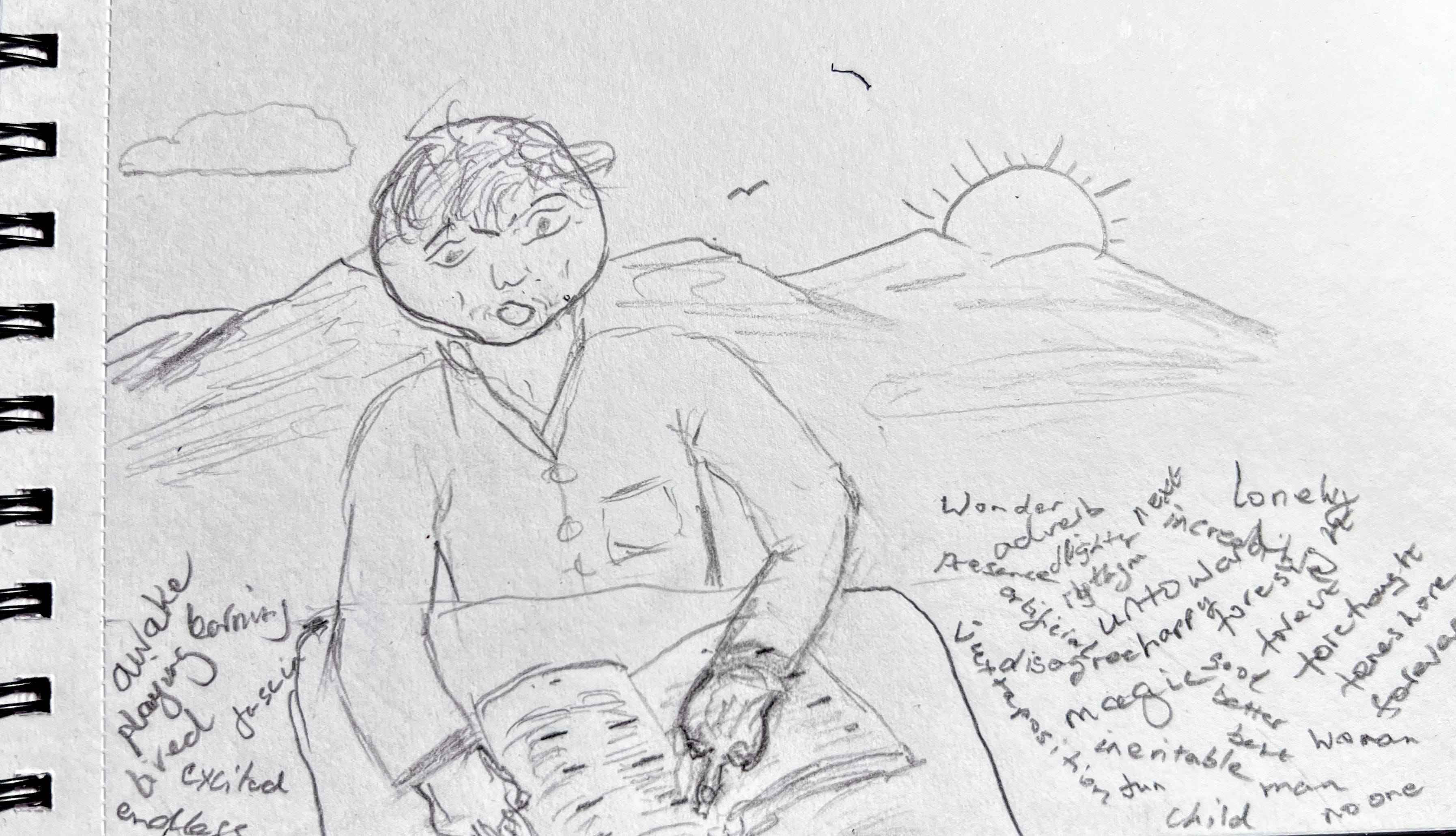
I wandered lonely in the Cloud…
There is a boy—small, perpetually wondering, constitutionally incapable of looking something up and leaving it at that—who has never entirely left me. He is the reason I once went to the dictionary to find out how to spell necessary1 and emerged, blinking, thirty minutes later, having also learned what a nef was (a ship-shaped table utensil, since you ask), the origins of nefarious, and the precise distinction between necromancy and nigromancy. He is also, I suspect, the reason my vocabulary is what it is today. Had he grown up with a search bar, I’m not sure he’d have fared as well.
This is an essay about dictionaries. But it is also about undertakers.
⸻
Bear with me.
Last week I went looking for the etymology of entrepreneur—that word so beloved of business self-help gurus and assorted motivational posters, conjuring images of the self-starting success story disrupting markets with a laptop and a vision board. The word is French, naturally: entreprendre, to undertake, from entre (in the midst of, engaged with) and prendre (to take). A risk-bearer. Someone who buys at certain prices and sells at uncertain ones. That is how Richard Cantillon used it in the early eighteenth century—nothing heroic, not mythologised, just someone willing to absorb uncertainty.
Then I pulled the thread a little further, the way I do, and found myself standing next to an undertaker.
Undertaker is the English calque of exactly the same idea. Not sous—below, as in underground, as in where the bodies go—but the older Germanic sense of under meaning in the midst of, engaged with, in the act of. To undertake was to take something in hand, to commit to a task. Undertakers once organised theatre productions, building projects, colonial ventures. They managed and coordinated. Eventually one specialism swallowed the word whole, and now we associate it exclusively with coffins and hushed voices and the particular cologne of condolence.
Meanwhile, English borrowed entrepreneur back from French in the nineteenth century, and the two words—cousins, functionally identical in origin—went their separate ways. One narrowed to death while the other inflated toward mythology.
I would never have found any of this with a search bar. A search bar would have given me a definition, a pronunciation guide, perhaps a usage example. It would have answered the question I asked and nothing more. The dictionary gave me the question I didn’t know I was asking.
⸻
This is what I mean by structural serendipity.
The physical dictionary—that heavy, slightly musty object nobody under forty keeps on their desk anymore—was a wandering machine. I went in for one thing and came out with six. This was not me being undisciplined (I was, but that’s another story). It was simply because the architecture demanded it. The neighbouring entries were simply there, arranged alphabetically with the magnificent indifference of a Victorian filing system. I couldn’t help but notice them. My eye snagged. My physical scrolling finger paused.
Digital search is the opposite. It is precision engineered to deliver exactly what I requested and to suppress everything adjacent. It is optimised for the query I arrived with, and thus hides the discoveries I didn’t know I was capable of. The friction is gone, and with the friction goes the accident, and with the accident goes the find.
Wordsworth wandered and encountered daffodils. He didn’t Google them. The daffodils were adjacent.
Relevance is the enemy of discovery
The dictionary is just the clearest example of a wider phenomenon. The algorithmic feed, the recommendation engine, the curated playlist—all are built on the same premise: that I want more of what I already want. It’s assumed that my taste is a fixed quantity to be served, not a living thing to be surprised into growth. The serendipity that used to be built into the structure of things—the radio playing something I’d never have chosen, the bookshop yielding a spine I’d never have noticed, the dictionary entry two columns over from the one I needed—has been systematically and systemically designed out in the names of relevance and efficiency.
Relevance is the enemy of discovery.
And my vocabulary—let’s come back to vocabulary, because it matters—is not built by looking up words I already half-know. It is built by colliding with words I had no reason to encounter. The small boy who fell into the dictionary and didn’t emerge for half an hour wasn’t building vocabulary. He was building a mind: associative, lateral, comfortable with not-knowing-yet, content to follow a thread wherever it led.
This is not inefficiency on my part. It’s one way I generate ideas.
⸻
I am not making an argument for inconvenience. I am making an argument for architecture—for tools and spaces that build productive accidents into their structure, rather than optimising them away. The physical dictionary didn’t wander with me out of sentimentality. It wandered with me because that was the only shape it knew how to be.
We could build digital tools that do the same. We mostly choose not to, because serendipity doesn’t convert.
Somewhere, a small boy is pushing through a thicket of words. He doesn’t know where he’s going. He’ll come out the other side knowing something he wasn’t looking for, and it will matter, and he will not be able to explain why, and that will be fine.
That’s the whole point, really.
I’m writing my book. Every day. And the dictionary is alive and well on my desk.

1 One collar. Two socks. Magick.
The Fertile Void Café is a reader-supported publication. If you find these essays useful, or at least mildly diverting, consider becoming a paid subscriber — or browse in the shop for something small and physical to hold in your hand.
Well said Matthew. I could not agree with you more.
I also love the feel of the thin, smooth paper in my dictionaries before I even get to the actual pages I want, or indeed finish upon some time later. And it taught us the necessity of knowing the alphabet and how to basically spell or guess the word we were looking for very early on. Oddly enough Austin Kleon was only talking about the value of physical dictionaries and Thesaurus he still uses today on the Joanna Penn podcast this week. P.S. Love the one collar two socks! Not heard that one. Good Luck with the deadline.
Fabulous thought provoking essay 🩵