


A note from the editor (me).
Before you read, please know that this one is longer than usual at around 2,000 words and seventeen minutes on audio. It’s also my last full essay for a while; the book I’m writing is calling and won’t be ignored. I’ll be back with something substantial in September. In the meantime, Notes and shorter pieces will keep things ticking.
I hope you make it to the end; whether you do or not, thank you for reading.
1965
I’ll pick a living room.
(We moved a lot.)
No fitted carpets.
No central heating.
Floor boards, painted dark maroon.
Large, Indian-style patterned carpet.
Mottled-beige tiled fireplace, assorted ornaments at waist height.
Copper coal scuttle, dented, scuffed, familiar, warm. Even before the fire is lit.
Overwrought fire irons, the brush always singed from shooing hot coals off the hearth.
Brown, leather sofa, two matching armchairs, the trio bearing the mysterious (to me) collective name: “three-piece suite”.
Two aloof standard lamps (in opposite corners).
Formica-topped table in the bay window, looking out over the grass, on to the orchard and the fields below.
Long red velvet curtains.
A leather pouffe for Dad’s feet.
Occasional table by his chair.
(What are occasional tables the rest of the time? - standing family joke.)
Ginger and more ginger cat - Cooper, after the marmalade.
Floral wallpaper - not Mother’s choice. We were RAF.
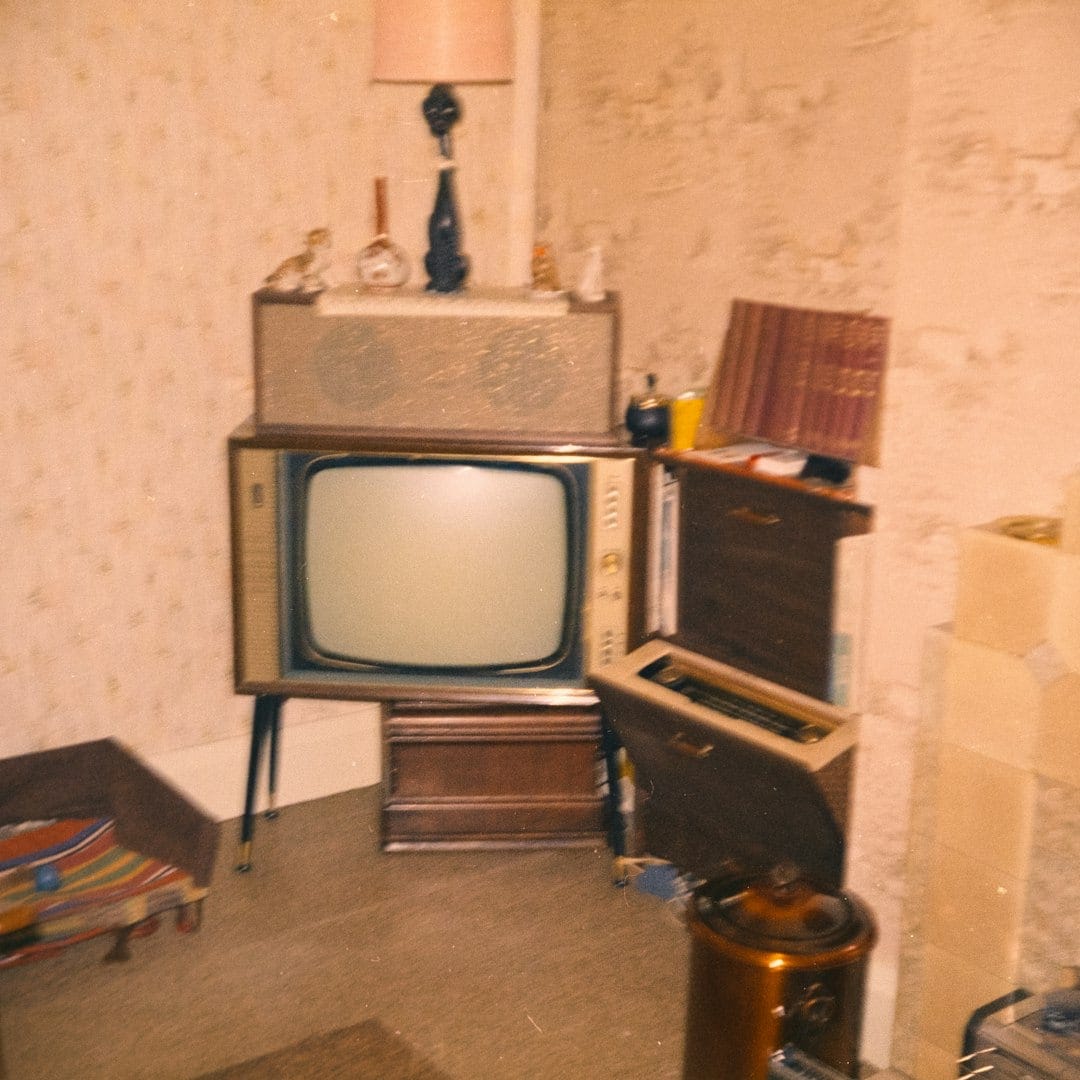
TV to left of fireplace. Four screw-in legs, splayed for stability. A slightly bulging square of greenish glass, deeper than it is wide. A few minutes after being switched on, it comes to life in glorious black and white.
Two circular controls. BBC or ITV; Volume- On-Off.
Cloth-covered twisted wire to the wall.
Laying the fire: my job.
Dad taught me.
Mending fuses too—inserting thin, pliable fuse wire—if he is away.
Not my older brother’s job.
Mine.
I’m ten.
Sitting with Mother, my sister on her other side.
Older brother upstairs in his room.
(I have to share a bedroom with my sister; David is now a young man. No one really knows what he does upstairs.)
My mug of tea, milky with two spoonfuls of sugar, when I can get away with it.
Dad’s in his china cup, with its saucer. He’ll pour a little into the saucer to cool it, then return it to the cup.
Always china. Always three quarters of a spoonful of sugar.
The tea made in good time for us all to be sat in our places as the screen comes to life with unsteady credits.
What’s My Line - a panel game show, transplanted from the radio.
The host begins by introducing the evening’s guests, who come up on the screen, first as the whole panel and then in close-ups. You can almost hear the camera being moved forwards.
I have no idea how a TV studio works. It is just the telly.
Nana … always saying “Goodnight” back to the newsreaders
when they finished the bulletins
The people on the show polite, smiling, in best clothes.
Occasionally a sequin or a piece of jewellery catches the studio lights, dazzling the camera so we see a bright white dot in a dark halo.
Panellists asking questions; the chosen ordinary person answering.
All seems absolutely normal.
We haven’t yet been given Ken Loach’s Cathy Come Home. John Pilger’s reports from Cambodia, exposing the lies of politicians on the war in Vietnam, still in our future.
In truth, I remember very little of the game show’s content. Except Mother and Dad guessing. For me this is about the comfort of a family event—no choosing when to watch, routine established by the programme schedulers.
Nana, Mother’s mother, always saying “Goodnight” back to the newsreaders when they finish the bulletins. She only watches it on the BBC; ITV’s isn’t proper news.
1982
Another living room.
I’ve been here on my own for a few months now.
A small semi in Nondescripton-on Soar, somewhere in the Midlands. A slouch settee, comfortable enough to suit all imaginable uses and postures, is partnered by a couple of utility easy chairs. Opposite these, where a family home might have had a pretence of a fire or possibly a large TV set, or both, is my hi-fi. It’s very hi fi. Stacked on its own black ash table: Akai 4000 DB reel to reel, Akai compact but powerful amp, pre-amp, tuner and twin cassette deck, with green graphic channel displays, the whole topped by a Garrard belt-driven turntable that six months ago had cost me half a month’s salary. Flanked by a couple of room-dominating Wharfedales, this source of music is the room.
As a young man with no cares in the world, or at least none I am about to admit to, music is my thing. Not telly - I’ve grown bored with its standardised output.
There is a TV, though. Not a big one and not particularly special. Just sitting there, in one corner. Gets switched on occasionally when I am not down the pub. Or away in the Alfa.
I don’t even get the Radio Times any more.
In this ordinary room in an ordinary town,
something different was being offered.
I do read The Guardian. Partly this is a symbol of separation from my parents, who read The Daily Telegraph, The Sunday Times but also take The Observer (which latter is where I discovered the wisdom of Charles M Schulz and Peanuts). That’s back home where Coronation Street is a twice weekly must-watch and even topical at times. (Mother had been in repertory with some of the original cast back in the day.)
Before leaving home, I’d adopted “quiet rebel” for my persona. And I believe this to be the real me. So when I see the article about the arrival of a new TV channel, one that answers to something other than the ad-men shaping our lives elsewhere, and because the Guardian says this is A Good Thing, I watch its opening night. 2nd November. A Tuesday.
Opening a bottle of beer, or three, lighting a Rothmans King Size, I sit back as Channel 4 - C4 - moves into its showcase offering - a long, detailed, hard-hitting thing about animal welfare. I already know some stuff about animal welfare, or more accurately, the lack of it, in food production chains. I know what happens to the phlegmatic cows in bucolic scenes on rolling grassy hills. And I have read about how egg production is made commercially viable.
I am immediately aware how significant this is. Panorama may not yet be cut to 30 minutes. Kenneth Clark has been given an age in which to do his best to civilise us, though without success.
But this, C4 tonight, this is unapologetic and important.
In this ordinary room in an ordinary town, something different is being offered. A real, unflinching exploration, laid out for anyone with ordinary intelligence to take in and make up their own minds.
After forty years, I don’t remember much of the content of the documentary either. But at the time, I am appalled, although not surprised. I’m a couple of years shy of thirty, only slowly forming moral objections to using animals for food. Essentially still pretty naive. Much of the programme blurs and blends with later discoveries that led to my time as an animal rights armchair activist (although I did once storm a beagle farm) and going vegan in the late 90s. What I do remember, that evening, is being part of Something.
For a little while, I feel morally superior. This broadcast is not mindless “entertainment” (aka tranquillisers).
Simply watching it makes me one of the Good Guys.
2000
In a small terraced house in a small unadopted terrace in a small Northern city, we are in our small living room, crowded with second hand furniture and a large TV set. Y2k has come and gone without incident. TV dramas with trauma themes of the day have become commonplace and largely predictable though occasionally edgy. Brookside, always ready to tackle an issue, had paved the way and acquired Anna Friel which makes it a compulsory middle-class intellectual soap opera. Even Grange Hill is doing its bit, much to my teacher-brother’s disgust.
Me? I have a new partner, both of us keen to understand how people work. We have sat down in eager anticipation for Big Brother—a live TV event—different, intriguing and interestingly, for two serious explorers of human relations, psychological.
more likely to cause controversy than seek to get along
We avidly follow the twists and turns of action in the House, debate the diary room discussions and soak up the analysis from the experts. She has Nasty Nick sussed early on, as much from the media output as from observing him directly. And we are both celebrating—yes, really—when the scouser wins.
Encouraged by what we had seen in Big Brother 1, we start watching Big Brother 2. I tire first. The new contestants—not exactly run of the satanic mills, are they? An ex-nun, I seem to recall. And the others more likely to cause controversy than seek to get along. I stop watching. She stops soon after, when she sees that the experts no longer display any expertise but instead appear to have been recruited from the ranks of recently redundant tabloid sub-editors.
We called it reality television. We should have noticed the irony sooner.
2010
A couple I know, from Hull, were selected (sorry, invited) to appear on a daytime confessional show, agreeing to air their differences live onscreen and hoping for resolution, if not absolution. Or that was the pitch. Modest fee but it came with a chauffeured drive down to the London studio, overnight hotel accommodation when the show was done (not the night before) and all reasonable expenses covered.
In the pub, this evening, she is telling me what happened.
The show started before they got anywhere near the studio; it started in the chauffeured car.
They were collected at an almost ungodly hour - 4:30am - by a nice young man in smart casuals, driving a “big fancy car”. On the long drive, as dawn broke and the world woke up, the young man had started chatting with them, normal stuff at first - how long they’d been together, any kids, what did he do for a living. Followed by more pointed questions—how did her partner feel about her being at home while he had to go out to work; would she not take a job if she could get one; must be hard to keep up appearances like you did when you met now there’s only his wage.
The show started before they got anywhere near the studio
The young man consistently nodded in sympathetic agreement with everything her partner was saying. Including when he says he “strayed” only because he wasn’t appreciated at home and even though he knew it was wrong, it was understandable, wasn’t it? The smartly dressed young man, part of the production company team, had nodded sagely.
And when she had tried to put her side of things—they hadn’t reached London yet—he had smiled knowingly, with comments like “you gotta work at a relationship, don’t you, darling?”
By the time they were dropped off at the studio and escorted on to the set by some bright young thing from PR, the couple were exhausted, already alternating between frozen silences and heated words.
2026
In our peaceful, minimalist living room, a different dawn breaks, in a quiet village somewhere just off the edge of the known world. The fire is our focal point. My new hi fi is less ostentatious but the sound is quite good enough. The TV, a modest 43 inches, is once again off to one side, out of the way.
I’m reading about a Panorama programme—all 29 minutes of it—that reveals three women, contestants on Channel 4’s show Married At First Sight, have described how they had been raped or sexually assaulted by their on-screen husbands during the filming of the flagship reality TV show.
Channel 4’s initial response is swift. A brief statement to reporters from its CEO emphasising that all claims remain “uncorroborated and disputed.” No apology.
And that from a woman too.
a global franchise where Peeping Tom meets Andrew Tate
Contestants are required to stay in the set-up—even if they wish to leave—unless their “spouse” agrees to allow that.
Is this not a central feature in the epidemic of real-life domestic violence, abuse and coercive control we begin to see reported every day? And presented here, for our entertainment? Yet we are not marching against MAFS, we are sitting down to watch and enjoy it.
What was once a social experiment in Denmark is now a global franchise where Peeping Tom meets Andrew Tate.
I’ll leave it to others to comment, expand and decry the actions of such men, not because I fail to be disgusted but because I want to look at another aspect here: how the normalisation of devaluing women in a patriarchal society means that this show can exist, and worse, be top rated with an audience of over three million.
We are so inured to this that otherwise reasonable, decent, human-values-driven people I know, it turns out, have been watching this show—with their families. A more than decent friend, genuinely disgusted by what the men had done, nevertheless offered this when we talked about it: “I guess it’s people chasing their five minutes, willing to take the risk for the social media following.”
I recognised the shape of that sentence. It’s the same shape as another one. You know the one: “but dressed like that, she was asking for it.“
Today
So, what can we do?
It doesn’t require legislation.
It doesn’t require Ofcom to grow a spine.
It doesn’t require Channel 4 to rediscover its founding mission.
It requires nothing except individuals making a small, undramatic choice.
Turn it off.
Related Essays
The Fertile Void Café runs on readers, not algorithms. If this essay made you think — or made you uncomfortable in a useful way — consider subscribing. And if you’d rather hold something real in your hands, our shop has that covered too.
such a fabulous trip back through sitting room's of old, Matthew. It is odd to realise the weight of the abuse against women over the years. In fact the longer one looks the more one sees how far back in time the abuse of power spools - not exclusive to women I might add. It's odd and uncomfortable being a woman, knowing what the physical abuse reported about would feel like. Understanding the power-protocol between the sexes; and accepting it. Things are different now, but not in as many ways as you think. Evolution takes time to truly shift norms. We must remain committed to the cause. A great read, thank you Matthew.
I enjoyed this Matthew, thank you. I don’t watch much telly and definitely not reality telly. I, like you, watched the first series of big brother, maybe a little of the later ones. My mum loves them and watches them all, and also watches Married at First Sight. I wonder how she feels now knowing that for her entertainment women were forced to suffer? It’s such a betrayal of their loyal audience in their pursuit of good telly. Poor show.